CompleteAll projects
DIVA, depth-intelligent navigation for the visually impaired
A wearable navigation aid for blind and low-vision users, built to cost a few hundred dollars against surgical alternatives that run into the tens of thousands.
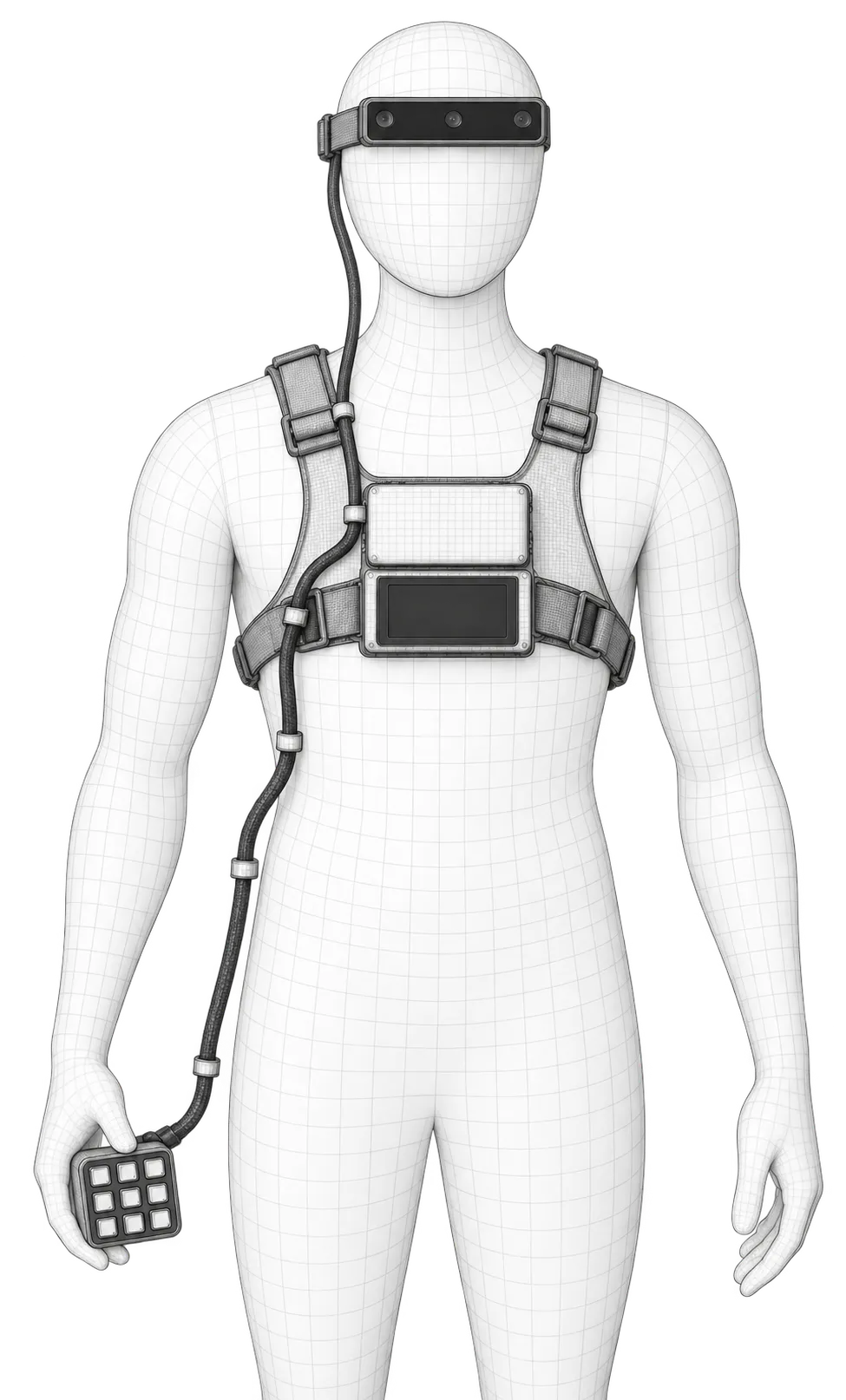
- Marked at upper centre of the drawing.
- Marked at upper centre of the drawing.
- Marked at centre of the drawing.
- Marked at centre of the drawing.
- Marked at lower left of the drawing.
Description
The problem
Around 340 million people live with visual impairment, 43 million of them completely blind. The white cane is still the common aid and only an estimated 2–8% of people use one: it reads the ground a step ahead, takes practice, and tires the arm. The alternatives, such as GPS wearables, infrared motion tracking and instrumented canes, work, and cost more than most of the people who need them can spend.
DIVA takes a different route, called sensory substitution: read the space with a camera and hand it to a sense that is still available. Here that is touch, with sound as a second channel.
How it reads a room
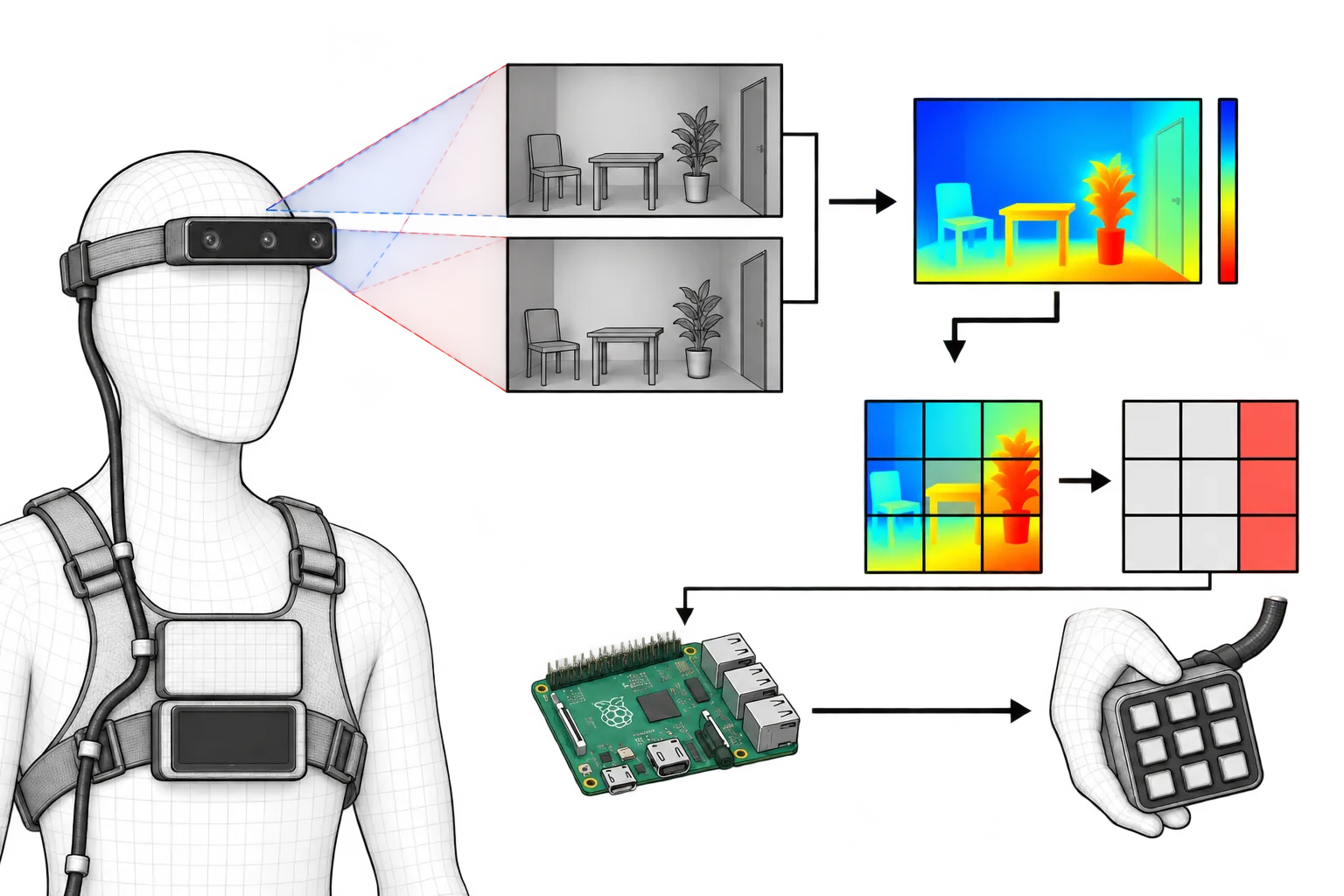
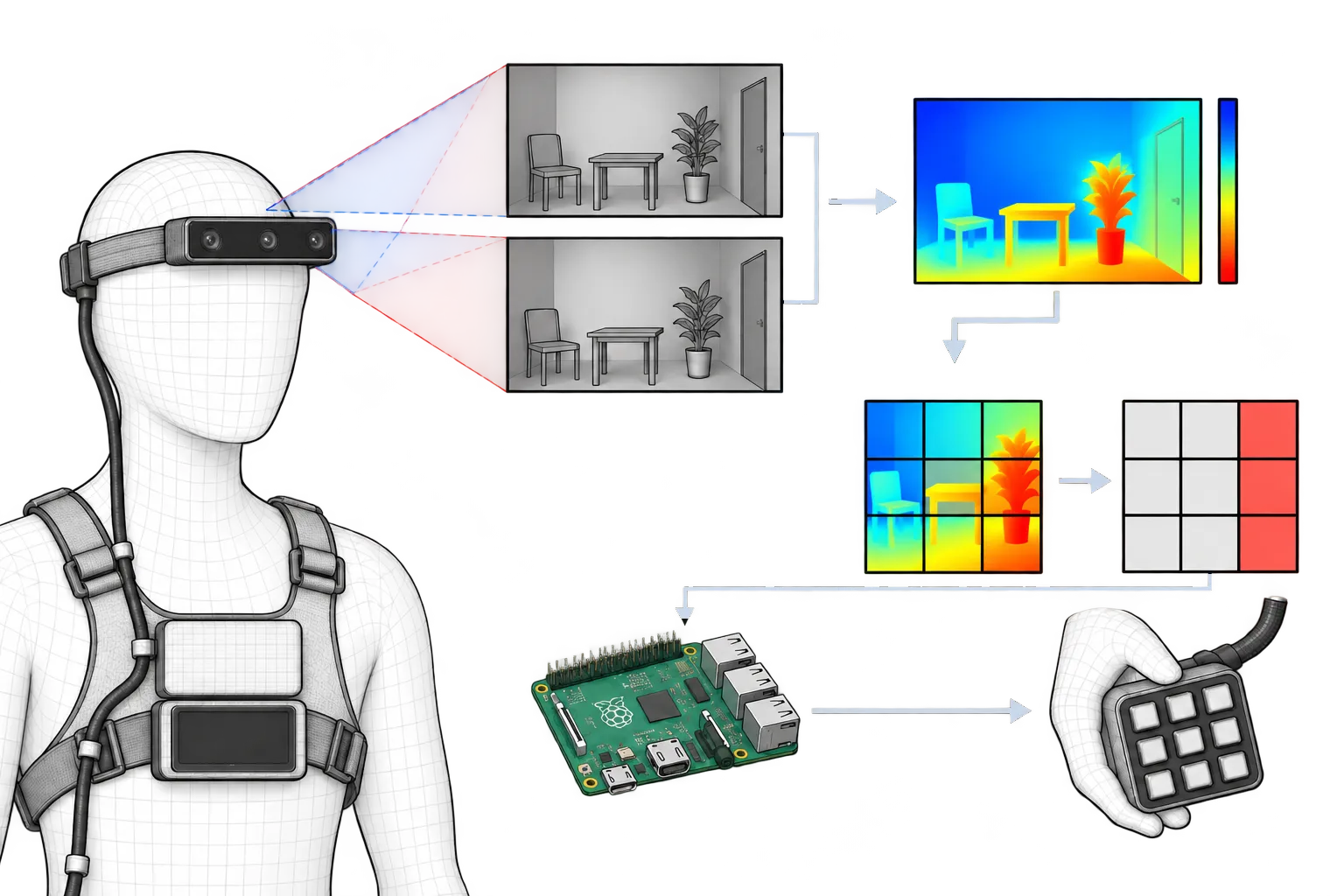
A stereo camera on a headband sees the scene twice, a few centimetres apart. Comparing the two images, by how far a given patch of the picture shifts between them, gives the distance to everything in view, the same way two eyes do.
That depth picture is divided into a 5×5 grid. Each square is reduced to one number, its average distance, and compared against a threshold the wearer sets. Anything closer than the threshold marks that square as blocked. A Raspberry Pi does this on every frame and sends the grid over Bluetooth to the hand unit.
How it tells you
The hand unit is 25 actuators in the same 5×5 arrangement, so the grid in front of the face maps onto the palm, so top-left of the view is top-left of the hand. Each cell is a flat coil printed on polyimide under a silicone pad with a small magnet in it. Run current through the coil and the magnet is pushed away, so the silicone lifts into a bump you can feel; cut the current and it settles. A nickel-iron shield around each cell stops one bump triggering its neighbours.
Touch says where something is. Sound says what it is. A U-Net network trained on the COCO dataset labels the objects in view across 80 classes, the nearest point of each is looked up in the depth map to get its position, and the name is played through earbuds using head-related transfer functions, so the word arrives from the direction the object is actually in.
What the testing showed
Depth. Three objects at eighteen distances from 0.5 to 5 metres, three trials each: the camera’s distances were off by 3.4% on average, drifting slightly wider with range.
Reading the hand. Four blind and four blindfolded-sighted participants identified which actuator had fired, across 25 random firings, three times over. Blind participants averaged about 21.8 correct out of 25; blindfolded sighted participants about 17.7. Within the blind group, those with no sight at all scored higher than those with partial sight, which is the pattern you would expect if the difference is practised sensitivity to touch.
Walking a course. Nine blind and nine blindfolded participants crossed a ten-obstacle indoor course with no aid, with a white cane, and with DIVA. Collisions fell from 7.7 per run unaided, to 3 with the cane, to 1.2 with DIVA, and DIVA runs were about ten seconds quicker than cane runs.
The segmentation model itself reached 84.7% precision and 80.2% recall, with an IoU of 0.744 across the 80 classes.
Cost, and what it still needs
The whole device comes to about $278: $149 of that the stereo camera, $73 the controller, $56 the tactile array. That was the point, given where most visually impaired people live. Three builds got it there: the first weighed 6.84 lb, the third 2.78 lb, most of the saving from moving the actuator drive onto its own board and cutting the cable to the headset.
The participant groups were small, and everything was tested indoors. Outdoor use, a finer tactile grid, battery life, and GPS for route-level guidance are all still open.